Our greatest President was Abraham Lincoln. And while most Americans acknowledge that, most also have only a vague idea of why. If Washington is known as the Father of our Country, Lincoln was the savior of it--preserving the fragile Union in the crucible of the Civil War. People also have a vague notion of Lincoln's humble beginnings, but most don't know that he lived in abject poverty on the American frontier. And, thanks to his immortal Gettysburg Address, most Americans know that Lincoln's skills as an orator stand unparalleled--but there are many other examples of his astonishing eloquence that are left to us.
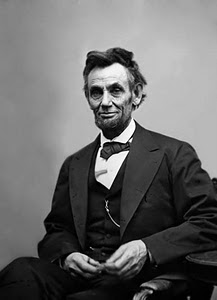
Abraham Lincoln was born in a one-room cabin on February 12, 1809 to Thomas Lincoln and Nancy Hanks Lincoln--the son of two farmers in Hardin County, Kentucky. At the time, Kentucky represented "the West" to most Americans--the hard frontier where settlers were scratching out a living and on constant watch from Indian attacks. Lincoln's mother died when he was 9 and, though he was very close to his stepmother throughout the rest of his life, he became estranged from his father.
Because of the family's need for Lincoln--even at a young age--to help with tasks on the farm, he received only a cumulative eighteen months or so of formal education. He loved school and loved learning--and was known to devour books, having essentially taught himself to read and write (his stepmother was illiterate). As he got older, Lincoln became fascinated with the English language--with the intricacy of words, their meanings and the cadence of their pronunciation. As a young man he studied the law, on his own, and passed the Illinois bar on his first attempt.
He became a successful itinerant lawyer. In those days on the frontier, the population was too sparse and too far away from the county seat to have justice meted out at the courthouse. And so the courts would come to the people. It was not uncommon for the judge, the district attorney, and the defense attorney to ride a circuit together throughout their jurisdiction to hear and argue cases in various towns and villages. This Lincoln did successfully for year, building a prosperous law practice in Springfield, Illinois. It was also during this time that Lincoln saw firsthand the power of the spoken word and how arguments could be influenced through the crafting of a well-turned phrase.
Lincoln joined the nascent Republican Party when it was formed in the 1850's. Although he had been a Whig all his adult life, the Republicans sought to more clearly articulate the brewing conflagration over slavery. It was during this time that Lincoln ran for--and lost--the battle for the Illinois Senate seat with Stephen A. Douglas. The Lincoln-Douglas debates leading up to that election pitted two oratorical rock stars battling for the hearts and minds of their fellow citizens.
Six years later, Lincoln found himself battling Douglas again--this time in the Election of 1860 for President of the United States. It was a surreal political landscape. Lincoln was the sole Republican nominee. But the Democrats were badly split over the slavery issue--with Douglas representing Northern Democrats and two other candidates representing Southern interests. Lincoln's election actually served as the breaking point for many of the Southern states. Barely a month after his election, South Carolina formally seceded from the Union, followed by six other states during the winter prior to Lincoln's inauguration.
It was during that inauguration that the nation first got a taste of Lincoln's remarkable phrases. His appeal to the Southerners not to allow their fervor to devolve into civil war is striking:
"I am loath to close. We are not enemies, but friends. We must not be enemies. Though passion may have strained it must not break our bonds of affection. The mystic chords of memory, stretching from every battlefield and patriot grave to every living heart and hearthstone all over this broad land, will yet swell the chorus of the Union, when again touched, as surely they will be, by the better angels of our nature."
Four years later during his Second Inaugural, Lincoln spoke on the eve of the end of the terrible war which would ultimately leave more than 620,000 Americans dead. His tone was not one of a brash declaration of victory, but of humility before God, a strong arm of comfort to his countrymen, and a gracious hand of friendship to his enemies: "Fondly do we hope, fervently do we pray, that this mighty scourge of war may speedily pass away. Yet, if God wills that it continue until all the wealth piled by the bondsman's two hundred and fifty years of unrequited toil shall be sunk, and until every drop of blood drawn with the lash shall be paid by another drawn with the sword, as was said three thousand years ago, so still it must be said "the judgments of the Lord are true and righteous altogether.With malice toward none, with charity for all, with firmness in the right as God gives us to see the right, let us strive on to finish the work we are in, to bind up the nation's wounds, to care for him who shall have borne the battle and for his widow and his orphan, to do all which may achieve and cherish a just and lasting peace among ourselves and with all nations."
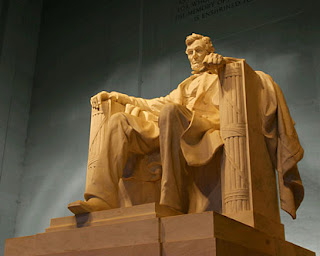
Five weeks later, Lincoln was shot while watching a play at Ford's Theater in Washington and died the next morning. The nation was wrapped in a paroxysm of grief for months. In the excruciating hours after he was shot, Lincoln's cabinet (except for Secretary of State Seward who was shot the same night), gathered around him. When he passed, Secretary Stanton famously said "Now he belongs to the ages".
 I've recently come across a little-known letter that Lincoln wrote in the early days of the Civil War to the parents of Elmer Ellsworth, who died in Alexandria, Virginia after he had torn down a Confederate flag and was subsequently shot by the owner of the hotel upon which it was displayed. Ellsworth was Lincoln's friend, a young protege of Lincoln who had worked with him in Lincoln's law office in Springfield, Illinois before he was elected President. He had formed a largely ceremonial detachment known as the Zouaves, a drill team that thrilled spectators with its exotic costumes and precision choreography. When the war began, Ellsworth--only 24 years old--asked for and received a commission in the U.S. Army and led the Zouaves as they were sworn into military service. Less than three weeks later, the young officer was dead--and the loss hit Lincoln hard.
 In the untimely loss of your noble son, our affliction here is scarcely less than your own. So much of promised usefulness to one's country and of bright hopes for one's self and friends have rarely been so suddenly dashed as in his fall. In size, in years, and in youthful appearance, a boy only, his power to command men was surpassingly great. This power, combined with a fine intellect, an indomitable energy, and a taste altogether military constituted in him, as seemed to me, the best natural talent in that department I ever knew. And yet he was singularly modest and deferential in social intercourse. My acquaintance with him began less than two years ago; yet through the latter half of the intervening period, it was as intimate as the disparity of our ages and my engrossing engagements would permit. To me, he appeared to have no indulgences or pastimes; and I never heard him utter a profane or intemperate word. What was conclusive of his good heart, he never forgot his parents. The honors he labored for so laudably and, in the sad end, so gallantly gave his life, he meant for you no less than for himself.


